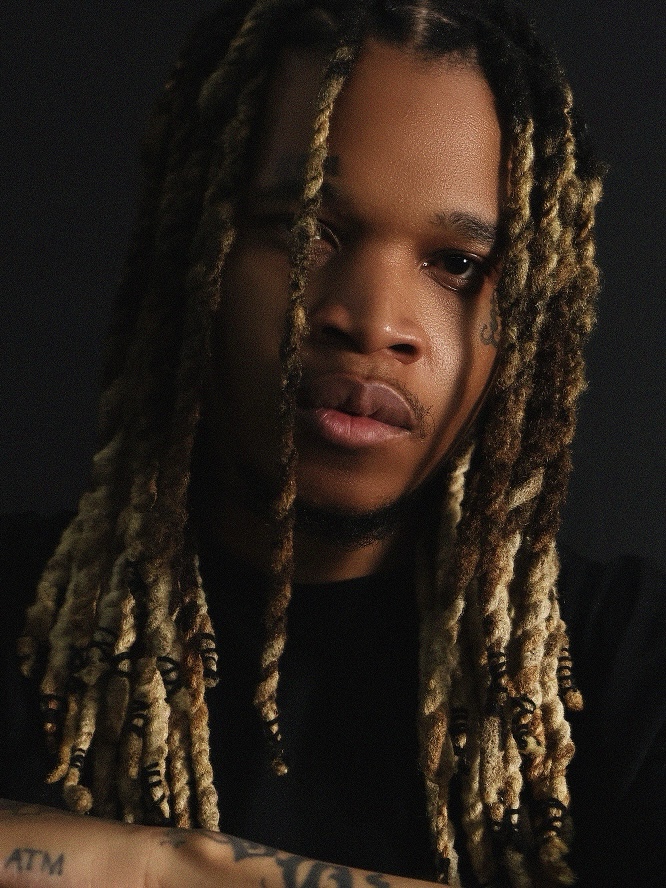
Hailing straight from Soweto’s Senaone township, we’re welcoming Saudi back to #LAChats and the South African music scene after taking a break. Growing up, Saudi was steeped in tunes from legends like Brenda Fassie, Michael Jackson, and Nina Simone. Music was practically in his DNA! At just 13, he cooked up his first track on a keyboard. High school was when things got serious – he teamed up with other aspiring rappers, forming Ozmuzik Victory Lane Over Everything (O.V.L.O.E), where he honed his skills.
But Saudi’s not your average artist. He’s got his own flavor, mixing Trap, R&B, and Afro vibes – a proven successful method that has been a testament to his success. After joining Ambitiouz Entertainment, he made even more waves, dropping hits like “Washa” and “Dreams.” And get this – he’s on the Grammy-nominated Black Panther soundtrack where he was featured alongside Kendrick Lamar, Schoolboy Q, and 2 Chainz in “X”. Saudi’s all about real stories and vibes in his music. He’s proof that staying true to yourself is the ticket to making it big in the music game.”
We had a chat with Saudi to hear more of his story, what he has been up to since he is back making music, and all about his plans in music.
Welcome back to Le’Afrinique, Saudi! Since our last interview in 2020 where we had a chat about your music journey at that time, your feature on the Black Panther soundtrack and Drips Leak Mixtape. You spoke a lot about change and growth you have experienced then, were you still experiencing some changes leading up to your comeback this year?
[SAUDI]: Thank you for having me back on your platform. I’ve been experiencing a lot of positive challenges and changes. There’s a lot of pressure on me because I haven’t dropped an album and/or a quality Saudi project since the release of my debut album. I had a lot to prove with my second album. The biggest challenge I had was trying to make an album that was even greater than my debut without it sounding like my debut album.
Taking a hiatus from music can be a transformative period. What prompted your break, and what did you learn during that time that we are seeing in your musical approach now that you’re back?
[SAUDI]: I don’t just express how I feel on my songs anymore, neither am I the kid who thought he would never make it out of his neighborhood anymore. Every song I make has a specific role and purpose. I pride myself in conveying my message through great songs. Songs people can love and relate to. Songs people can sing hopefully ’til the end of time.
Congratulations on the release of “Msotra Don’t Die” – we enjoyed it alot! This album is dedicated to maternal love and chasing dreams. What were the most significant sources of inspiration that shaped this album?
[SAUDI]: My mother. Her love. Her sacrifices. Her hardships. Her persistence. My undying desire to reach my full potential.
Collaborations often bring new dimensions to music. Who did you work with on this album, and how did these collaborations enhance the album’s essence?
[SAUDI]: I worked with Ruff, Young Tune, Emtee, J-Smash, Lunatik & Christer, and many others. Emtee is the only artist featured on my album and that’s on purpose. This album was personal and I swore I would show my talent on this one and I did just that.
Tell us more about the creative direction on the cover as well. Who did you work on it with and what is the story, emotion or message you want listeners to take from it?
[SAUDI]: I wanted listeners to be captivated and to listen to this album with the same amount of dedication as I had creating it. A picture of my mother on her wedding, with her head down as if she’s reciting a prayer. That’s just how determined I was to give the listeners the best of me. I prayed so much for this day to come and I wanted all the hardwork, dedication, sleepless nights, and prayers to really come full circle so I needed the cover art to resemble the blood, sweat, and tears I put in to make this project.
You mentioned that this album is a shift in your creative process. How did you navigate this change, and what aspects of your artistry have evolved or grown in this new project?
[SAUDI]: I took me years to navigate the creative changes & growth that I needed to have in order to complete this project. It also took me years to navagate and fully learn the business expects of bring a profession recording artist. I sing better. I write better, I don’t ever do too much anymore. There’s maturity, I found a balance between lyrical content and sonic content that I’ve never had before as a recording artist. I have better beat selection. I’m truly a whole new artist.
Can you shed light on how you repurposed scrapped records for inspiration? How did you maintain authenticity as the Maestro African Trapper while challenging norms in your music?
[SAUDI]: I took records that couldn’t be released and I used their Choruses and/or overall concepts. I took these and created new songs out of them since they would never be released or cleared because of a number of reasons. My music has never been normal. I think the only norm about my music is its uniqueness and it being so different from everyone else’s music. I have to be honest. I have to be in a space where I want to express how I feel. My authenticity is why I can’t just write every single song solely based on a concept. There needs to be quite a bit of truth in my music, my truth. That’s the reason people believe in my music. That’s why they’ve missed me so much and they still haven’t forgotten about me.
Given the album’s thematic focus on resilience and personal growth, how do you hope “Msotra Don’t Die” contributes to the broader landscape of South African music and influences aspiring artists within the sub-genre of African Trap?
[SAUDI]: Nationally I hope this album sets a certain standard in the quality of music South African artists create and release. That’s what I was concerned about contributing to and/or changing in the landscape of South African Music. I’ve been listening to all the artists that were prominent in my absence. All the artists that people love, the ones with the music South Africans love and I just thought the music could be a little better. I truly believe that if we all start taking our music seriously and treat the fans who listen to it with more respect, we can really make a name for ourselves globally. That’s what I’m going to do with or without anyone’s help. We as a nation have African Trap Music. A genre, a musical style, and a way of writing and singing that’s unique to us South Africans. Even when I when I focus on what’s next for me with my own genre JAPAN FOUR, it will still be a subsidy of African Trap Music.
“Msotra Don’t Die” appears to encapsulate a diverse range of emotions and experiences. How do you envision this album resonating with your audience, both locally and internationally?
[SAUDI]: This album, much like all my music, is nothing more than feelings. My music has always had more to do with feeling than anything. Pure and raw human emotion. Feelings, whether of heartbreak, triumph, excitement, or all various forms of pain. I want my audience to cry when they are on their own playing this album. I want anybody that feels like giving up on life to find refuge in my music. I want anyone who is living their best life to have their own theme music for and to the best times if their life. More than anything I want everyone to know that you can lose the whole world and all that you’ve ever had, all that you’ve ever earned and achieved, and still bounce back. Through focus, hard work, dedication, and resilience, the world is yours. Anyone that does not understand “isisZulu”, “Tsotsi-Taal” or “Hip hop Slang” can listen to any song on my album and completely feel the emotions, pain, frustration, love, and passion that’s in each and every single song on this album.
Finally, could you highlight one track from the album that holds particular significance to you and share the story or inspiration behind it?
[SAUDI]: “I Still Love You”. Track number 2 on the album. A dedication to my mother and the 16-year-old me. This is my way of putting to rest everything that was toxic about our relationship and my childhood. Finally letting go of all the hurt I’ve carried with me for years. When I was 16 years old I almost killed myself. At this point, I had already bitten off way more than I could chew when it comes to criminal activity. I was in way over my head. I was exposed to my environment and I wanted to be like the people who were respected in my community. I knew school wasn’t for me but I also learned that being like the people I looked up to wouldn’t work for me for very long. I remember coming to school at about 07h30 in the morning like I always do, except this time I had no books in my bag and I walked out of the gate before the gates were locked and school began. I had already decided I was going to stand right in the middle of the train tracks and put an end to my existence. I remember I sat up the whole night trying to make sense of my life. I did not have a positive image of myself. I hated myself but I hated life even more. On those train tracks, I learned that there is something I actually love. I remember I told God if he would make my dreams come true then I would do everything I needed to do to meet him halfway and he kept his promise. So instead of going through with it, I then decided to let go of school as a whole and focus on my dreams. I came to the realisation that if I can boldly take my own life, a life that I was given to me then there’s nothing scary or intimidating about any dream, goal, task or even human being. At the time my mother thought I had just dropped out of school but the truth of the matter was I had literally come this 🤏 close to killing myself that afternoon. I was broken both spiritually and mentally. The song’s lyrics say “I was standing in front of a train tryna end it, I reached out for a hug you told me you don’t want my demons.” These were some of the words and occurrences that had a very negative and destructive effect on me. I remember confessing to my mother that I had attempted to end my life and I remember crying, literally longing for a hug from her and instead I was rejected. She didn’t even want to touch me. I remember thinking what kind of monster or demon am I? that my own mother doesn’t even want to touch me. I had already disappointed them numerous times, so I already felt like I wasn’t anybody’s baby but on that afternoon when I told her I’m dying, the only thing I really needed was my mother’s love. These are the experiences I’ve overcome and some of the things I’m glad to say I’ve healed from. In this song, I finally bid farewell to the 16-year-old me. Freeing myself from my past and embracing love and prosperity and God’s blessing over my life.
Check out Saudi’s “Mosotra Don’t Die” visual album!
Featured Image(s) Source: Supplied
![[REVIEW] Doja Cat’s Move Afrika Set Proves She Is The Greatest](https://lamag.africa/wp-content/uploads/2026/03/doja-cat-e1774192061598.jpg?w=1024)
![[TREND] Celebrity “Then vs Now” Shows Up In “What Were You Like”](https://lamag.africa/wp-content/uploads/2026/03/zandi-nhlapo-e1774207541391.jpeg?w=638)

Leave a Reply